SOTA Physical AI models can't be trusted in production.
A model proposes actions. Nothing verifies them before they reach the robot.
Morix Robotics builds the enterprise-grade deployment engine for production robot fleets. It turns Physical AI models from demos into deployable systems: enforcing safe actions, tracking outcomes, and converting field failures into fixes.
A model proposes actions. Nothing verifies them before they reach the robot.
Morix runs inline between the model and the robot. Every action proposal becomes safe physical behaviour before it executes.
Every model action is checked against deterministic safety boundaries at runtime, before it becomes physical robot behaviour.
A failure is detected, root-caused and turned into a validated fix that propagates across the fleet.
Morix abstracts universal experience from every failure: failure signatures, recovery patterns, skill boundaries. They compound across the network.
The governed action path from model output to robot behaviour. Model agnostic. Hardware agnostic. Built for enterprise deployment.
The engine in the action path, on real hardware. Actions checked before they become motion, and the loop closing back to the model.
Morix sits in the action path between the model and the robot. Every model action is checked against deterministic safety boundaries at runtime, and the learned parts can never override the hard boundary.
Low level · per step
Deterministic checks on every proposed action: workspace bounds, force and velocity limits, payload and reach.
Model based · trajectory level
Continuous safety invariants over the whole trajectory: collision avoidance, joint-space envelopes, keep-out zones.
Learned · calibrated
Flags when the model is operating outside the skills it has been validated on.
Off the control loop
Routes the result into a graded recovery: retry, replan, then halt and call a human.
Gate budget
Sub-10 ms
inline, per control step
Placement
On robot
edge, in the action path
On failure
Retry · replan · halt
graded recovery
Audit trail
Compliance evidence
exportable, per action
01 / 06
Model-agnostic. VLA, RL, MPC or classical skills, behind one interface.
02 / 06
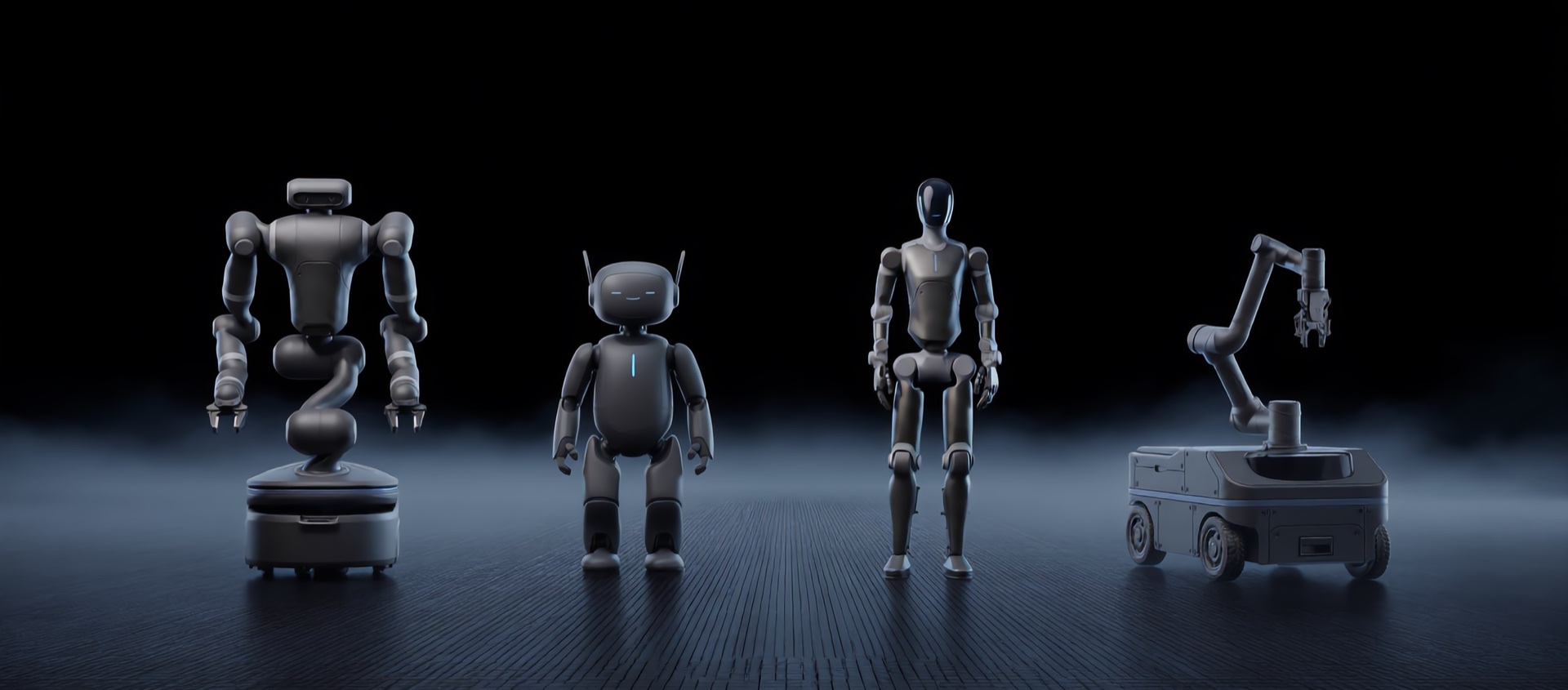
Humanoids, AMRs and fixed arms, on the same runtime.
03 / 06
The action path stays at the edge. Only telemetry leaves.
04 / 06
Detect, cluster, root-cause, fix. Validated fixes propagate fleet-wide.
05 / 06
Integrates with existing WMS, MES and ERP.
06 / 06
Full lineage from raw telemetry to live deployment, for every decision.
What comes back is the real-world field data that model validation pipelines lack.
Driving
Capability was real, and scale still waited on one thing: a layer that could stand between the model and the road and be trusted with the consequences. We helped build that layer.
Robotics
We are building the same layer for robots, before the industry needs it rather than after. The layer that sits in the action path owns the live workflow, the failure data and the customer trust. In driving, that is the layer that won.
Working with a deliberately small set of design partners
Robot builders
A safety runtime, not a research project.
Model companies
The field data your pipeline structurally lacks.
System integrators
Guarded deployment across every site.
Integration
Bring a checkpoint
Any policy behind one uniform contract, tracking community standards such as LeRobot. No retraining, and no rewrite of your inference path.
First step
One cell, in production
A guarded deployment on a single cell under real conditions, where the runtime is doing the work rather than a demo.
Then
Promote or roll back
Widen to the fleet once it holds, or roll back without stopping the line. Both are the same mechanism.
Tell us what you are deploying and where it stops being safe. If it is a fit, we will show you the engine running against it.